
What is bankroll management?
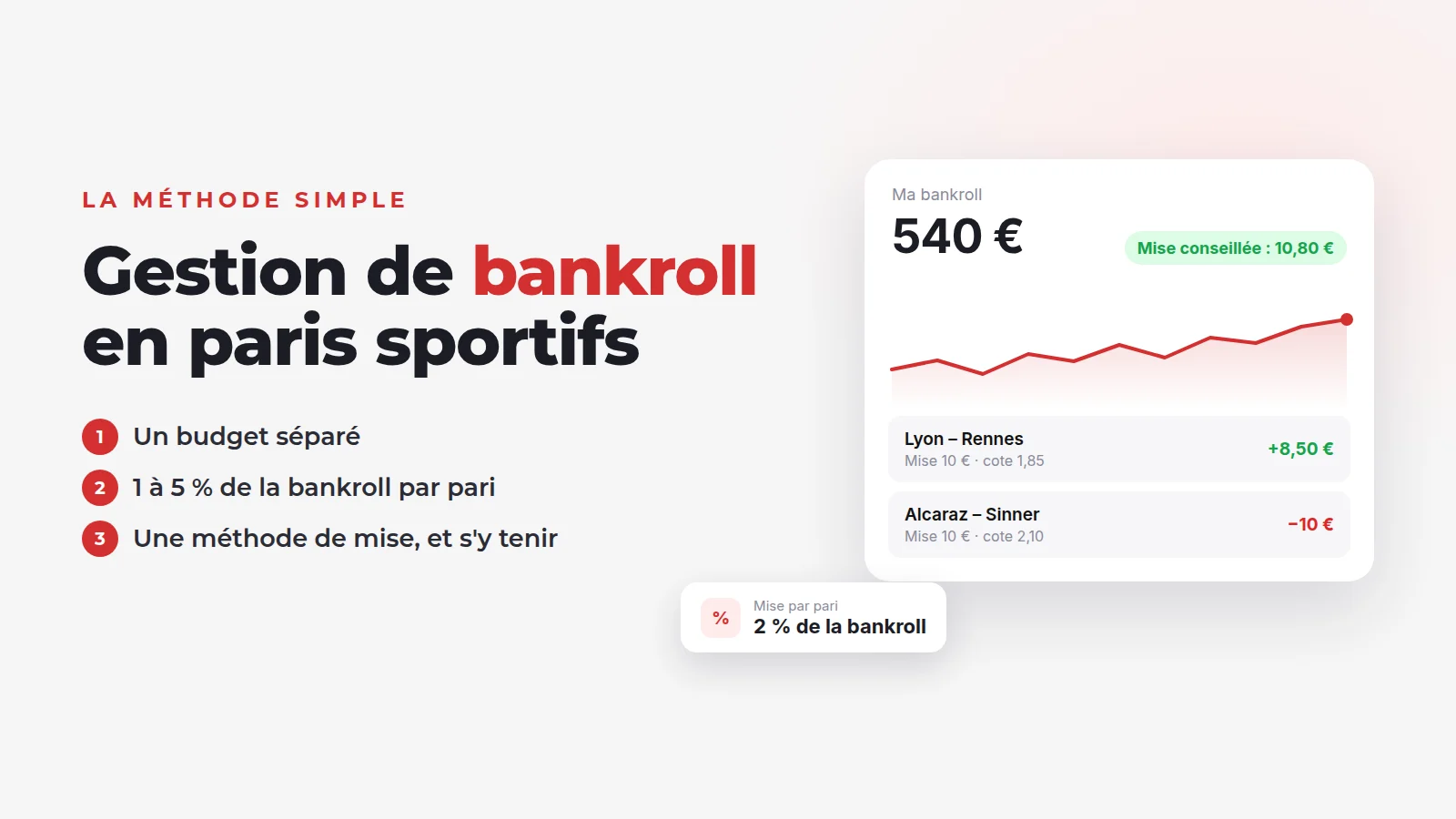
Your bankroll is the money you set aside for betting, and for betting only. Bankroll management is the set of rules that decides how much you stake on each bet. It does not pick your bets: it sets the size of your stakes.
A bettor who manages their bankroll applies four rules, always the same:
-
1
A separate bankroll
An amount decided in advance, that you can lose without touching your everyday budget. Ideally kept in a separate account or tracked separately.
-
2
1% to 5% per bet, maximum
Rather 1% to 2% at first. No “banker” justifies going over that cap.
-
3
A staking plan chosen in advance
Flat stakes, percentage or fractional Kelly: you decide it with a cool head, then you stick to it.
-
4
Every bet tracked
Date, odds, stake, result. Without tracking, you cannot tell whether your method works.
And one rule that sums them all up: never stake bigger to win your losses back.
Why manage your bankroll: 10 losses in a row
Even a good bettor hits losing runs. At odds of 2.00, with a one-in-two chance of winning each bet, a run of 5 or 6 straight losses will happen sooner or later over a few hundred bets. Bankroll management keeps you in the game during those runs.
Take a €500 bankroll and 10 lost bets in a row:
| Method | Stake | Bankroll after 10 losses |
|---|---|---|
| Flat stake of 2% | €10 on every bet | €400 (−20%) |
| 2% of your current bankroll | €10, then less and less | ≈ €408 (−18%) |
| Flat stake of 10% | €50 on every bet | €0 |
At 2%, you have lost a fifth of your bankroll and you can carry on. At 10%, the bankroll is empty before the run ends, and your analysis never gets the chance to prove itself.
Key takeaway
Staking plans for your sports betting bankroll, with worked examples
Four methods, from the simplest to the most technical, plus one to avoid. All the examples start from a €500 bankroll. To run the numbers with your own figures, use our betting stake calculator.
1. Flat stakes
You always stake the same amount, whatever the odds or your confidence. It is the easiest method to stick to, and the clearest for tracking your results.
Example: €10 on every bet, i.e. 2% of your starting bankroll. Remember to recalculate that amount if your bankroll drops significantly (for example, after every 20% loss).
2. Percentage staking
You stake a fixed percentage of your current bankroll, between 1% and 5%. Your stake goes down when you lose and back up when you win: the bankroll cannot drop to zero in one go.
Example: 2% of €500 = €10. If the bankroll falls to €400, the stake becomes €8. If it rises to €600, €12.
3. The Kelly criterion
A formula that works out the share of your bankroll to stake from the odds and your estimate of the probability of winning:
Stake (as a % of bankroll) = (odds × probability − 1) ÷ (odds − 1)
- Odds of 2.00, 55% estimated chance: (2 × 0.55 − 1) ÷ 1 = 10% of your bankroll, so €50.
- Odds of 2.50, 45% estimated chance: (2.5 × 0.45 − 1) ÷ 1.5 ≈ 8.3%, so €42.
- Odds of 1.70, 55% estimated chance: the result is negative. Kelly tells you not to bet: the odds do not pay enough for the risk.
The catch: everything rests on your probability. If you estimate it at 55% when it is really 50%, the formula makes you stake too much on a bet with no edge. And even when you are right, Kelly often gives stakes above the 5% cap.
4. Half-Kelly (fractional Kelly)
You work out the Kelly stake, then only bet a fraction of it: half, or even a quarter. This is the version most bettors who use Kelly settle on.
Example: Kelly gives 10% at odds of 2.00 and a 55% chance. Half-Kelly stakes 5% (€25), quarter-Kelly 2.5% (€12.50). Your bankroll swings far less, and an estimation error costs you less.
Avoid: the martingale
Doubling your stake after every loss to win it all back on the first win. On paper, it works. In practice, a few losses in a row are enough to empty your bankroll.
Example: starting at €10, 5 losses in a row cost €10 + €20 + €40 + €80 + €160 = €310. The next bet needs €320 to win… €10 (at odds of 2.00). With a €500 bankroll, you cannot even place it.
Which staking plan should you choose?
| Method | Simplicity | Protects you in a losing run | Best for |
|---|---|---|---|
| Flat stakes | Very simple | Yes, if the stake stays small | Beginners, clear tracking |
| Percentage | Simple | Yes, the stake goes down on its own | Most bettors |
| Kelly | Technical | Poorly, if you overestimate the probability | Bettors who model their probabilities |
| Half-Kelly | Technical | Better than Kelly | The same, with more caution |
| Martingale | Simple | No | Nobody |
Work out your stake in 10 seconds
Flat stake, percentage, Kelly and half-Kelly, ROI and yield: our free calculator does the maths for you.
Units, ROI and yield: measuring your results
To know whether your method works, you need figures you can compare from one month to the next and from one bettor to another. Three ideas are enough.
The betting unit (1u)
A unit is a reference stake, usually 1% of your starting bankroll. When a tipster advises “2u”, they are telling you to stake two units, whatever the size of your bankroll. That is why serious results are shown in units, not in euros or pounds.
Example: €500 bankroll, 1u = €5, so 2u = €10. With €2,000, 2u = €40. Same advice, same risk.
Yield and ROI
The figure almost everyone calls “ROI” in sports betting is actually a yield: net profit divided by total staked.
Yield
net profit ÷ total staked × 100. Tells you whether your bets are profitable, however many you place.
ROI
net profit ÷ starting bankroll × 100. Tells you how much your capital has grown.
Example: 30 bets of €10 = €300 staked, for a net profit of €24. Yield = 24 ÷ 300 = 8%. On a €500 bankroll, ROI is 24 ÷ 500 = 4.8%.
Strike rate and average odds
A strike rate on its own means nothing: it all depends on the odds. Your break-even point is 1 ÷ average odds.
- At average odds of 1.50, you need to win more than 66.7% of your bets to be profitable.
- At 1.80, more than 55.6%.
- At 2.50, more than 40%.
A 60% strike rate at odds of 1.50 loses money. A 45% strike rate at 2.50 makes money. Always look at the yield, and over enough bets: a few dozen bets is still mostly variance.
How to track your bets in a spreadsheet
An Excel or Google Sheets spreadsheet is enough to track your bankroll. One row per bet, with these columns:
| Date | Match | Bet | Odds | Stake | Result | Net profit | Bankroll |
|---|---|---|---|---|---|---|---|
| 12/10 | Lyon – Rennes | Lyon to win | 1.85 | €10 | Won | +€8.50 | €508.50 |
| 13/10 | Alcaraz – Sinner | Sinner to win | 2.10 | €10 | Lost | −€10 | €498.50 |
The formulas you need:
- Net profit: stake × (odds − 1) if the bet wins, − stake if it loses, 0 if it is void.
- Bankroll: starting bankroll + sum of net profits.
- Recommended stake: current bankroll × your staking percentage.
- Yield: sum of net profits ÷ sum of stakes.
Simpler than a spreadsheet: Typsa Bankroll
The free bankroll tracker app: log a bet in 10 seconds on your phone, with your profit, ROI and graph worked out for you.
The mistakes that wipe out a bankroll
Most bankrolls do not disappear because of a bad method, but because the method gets dropped at the worst moment.
Going on tilt
After a frustrating loss, you fire off bets with no analysis, often in-play. The decision is no longer rational. Simple rule: after two or three losses in a day, stop until tomorrow.
Chasing losses
Staking bigger to win it back. It is the martingale under another name. A loss is not won back: it is absorbed with normal stakes.
Staking too much
Above 5% per bet, a few losses are enough to put your bankroll at risk. It is the most common beginner's mistake.
Changing your stake with your mood
€5 on one bet, €50 on the next “because it's a sure thing”. No bet is a sure thing. The cap applies to all of them.
Raising stakes after a good run
A winning run builds confidence, then you loosen the rule. Percentage staking already follows your bankroll: no need to add more.
Not recording anything
Without tracking, you remember your wins and forget your losses. Record every bet, even the bad ones.
Two habits help you stick to it: only bet with licensed operators, and set a maximum number of bets per day or per weekend in advance.
Responsible gambling
Apps and tools to track your sports betting bankroll
Three options for bettors, depending on how much detail you want:
| Tool | Format | Price | Best for |
|---|---|---|---|
| Typsa Bankroll | Web, installable on iPhone and Android | Free | Tracking your bets day to day, simply |
| BettingTracker | Web, installable on mobile | Free for one bankroll, paid plans from €4.99 a month | Quick entry, calculators |
| A spreadsheet (Excel, Google Sheets) | File | Free | Those who prefer to build their own, with the formulas above |
Prices as of October 2026, taken from the publishers' websites and app stores; check them before subscribing. BettingTracker is independent of Typsa. If you follow a tipster, also check whether they offer bankroll tracking on their own website: websites built with Typsa do.
Are you a tipster? Your members' bankroll matters to you
A member who stakes 20% of their bankroll on each of your tips will not survive your first bad run, even if your results are good over the season. They get discouraged, they cancel, and they blame you. Your members' bankroll management is also how long your subscriptions last.
Three things to do:
- Give your stakes in units (1u, 2u) rather than in euros, with a reminder of what one unit is worth.
- Share your rules: cap per bet, recommended staking plan. This article can serve as a reference.
- Give your members a tracking tool, in the same place as your tips.
Bankroll tracking for your members
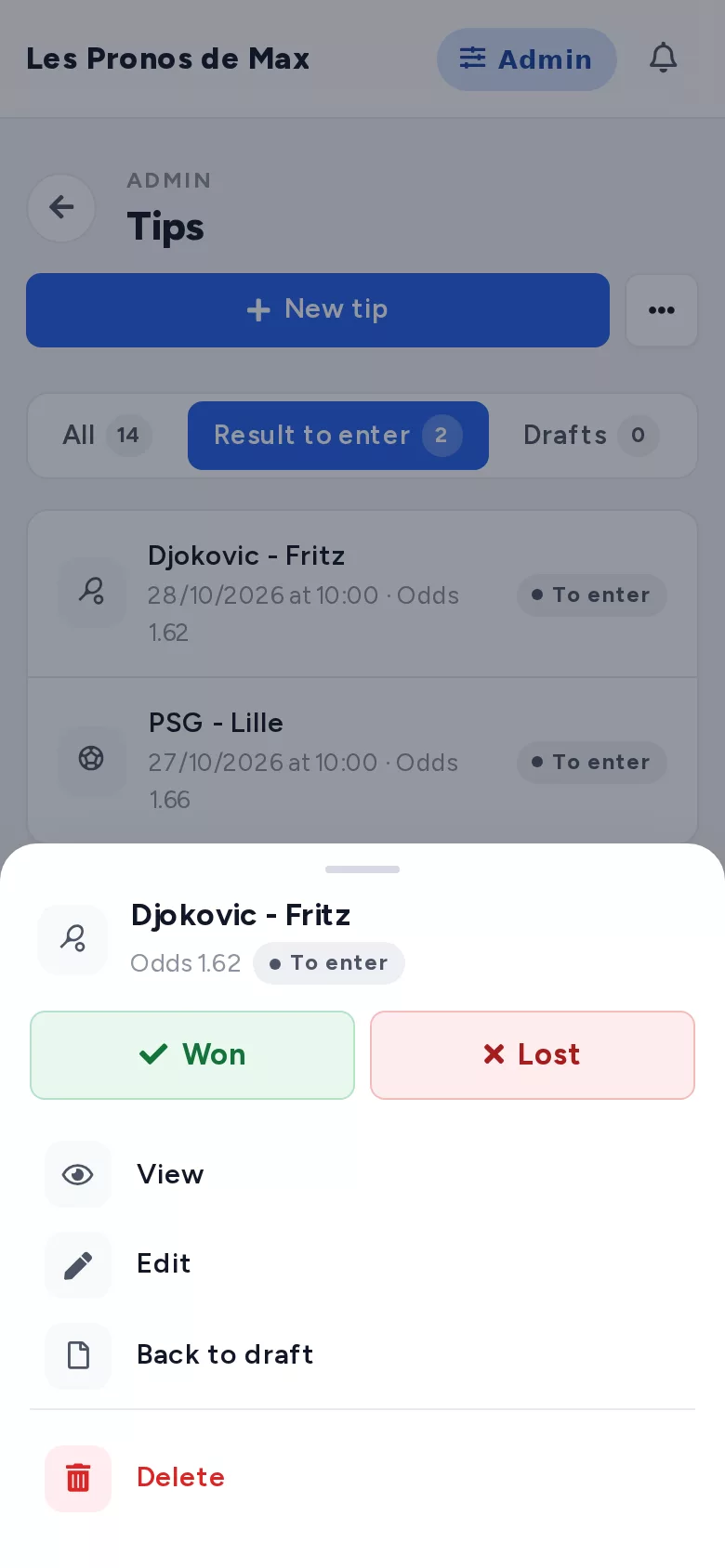
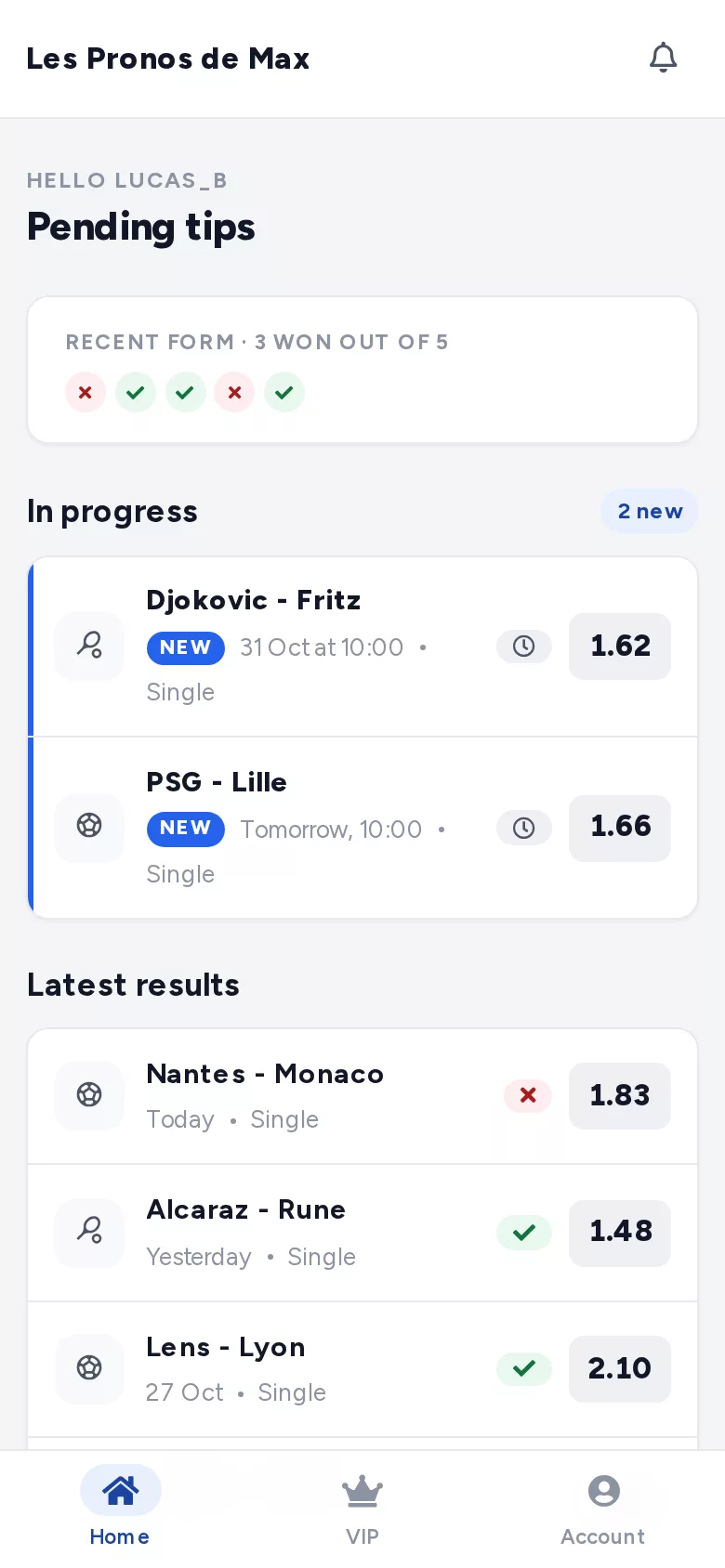
To structure the rest of your business, read our guides on how to sell betting tips and automating payments and VIP access.